Low-refusal models for coding and agents
Seven Abliterated, Uncensored, and Heretic Models Now Available on Infron
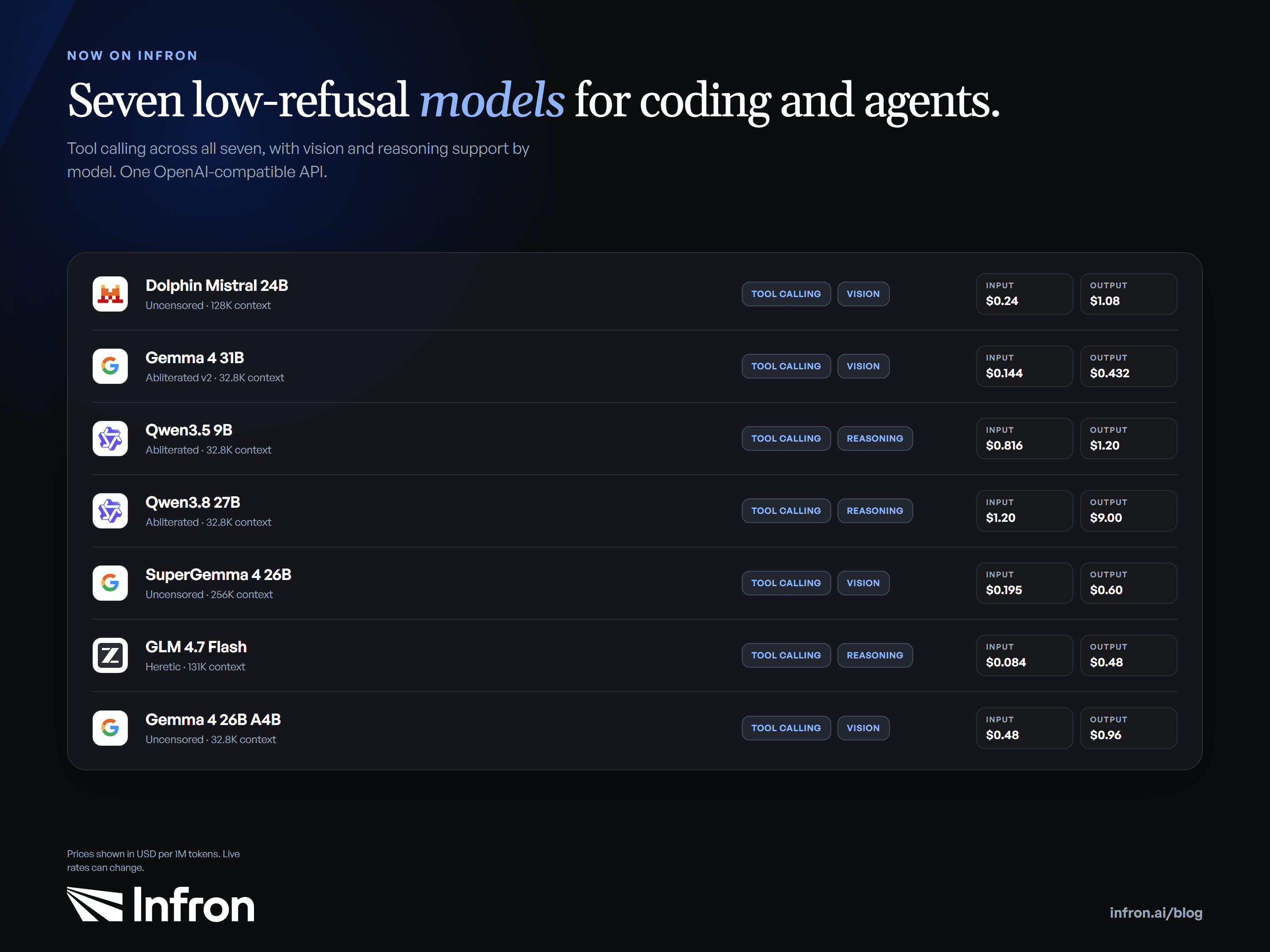
Models do not always fail because they lack the capability to complete a task. Sometimes they understand the code, the available tools, and the requested outcome, but stop before the work begins because an otherwise legitimate task contains security-sensitive language.
That distinction matters for coding assistants, security analysis, and multi-step agents. A false refusal at any point can interrupt an entire workflow before the model has examined the evidence, called a tool, produced a patch, or run a test.
Infron now provides seven low-refusal models across the Mistral, Gemma, Qwen, and GLM families. They use Abliterated, Uncensored, or Heretic approaches and are available through the same OpenAI-compatible API used across the Infron model marketplace.
The goal is not to make a model answer every request. It is to reduce unnecessary refusals in normal, authorized workflows while keeping correctness, tool reliability, permissions, and verification in the evaluation loop.
For a deeper explanation of the underlying technique, read Infron Abliteration: Model Behavior Optimization for Coding and Agents.
Seven models for different workloads
Model | What distinguishes it | Context | A practical starting point |
|---|---|---|---|
An uncensored fine-tune based on Mistral Small 24B, designed for steerable dialogue, creative work, and open-ended interaction. Tool calling is supported. | 128K | Creative applications, roleplay, and general-purpose assistants | |
A second abliteration of Gemma 4 31B Instruct. The hosted endpoint answers directly and retains image input and tool calling. | 32.8K | Code analysis, document understanding, and direct responses | |
A compact modified vision-language model with reasoning and tool calling. Thinking is disabled by default and can be enabled when needed. | 32.8K | Lightweight agents, task replay, and rapid prototyping | |
A targeted abliteration that retains coding, reasoning, vision, and tool calling. Thinking is enabled by default and can be disabled. | 32.8K | Coding agents, multi-step reasoning, and general automation | |
A community uncensored Gemma 4 26B A4B fine-tune served as an int4 GGUF, with an emphasis on conversational and coding workloads. | 256K | Long documents, large code contexts, and exploratory analysis | |
A Heretic-modified GLM 4.7 Flash checkpoint with 30B total parameters and about 3B active parameters. Reasoning effort is configurable and tool calling is supported. | 131.1K | Tool-based agents, long-context reasoning, and efficiency-sensitive workloads | |
A community uncensored Gemma 4 26B A4B build with separate edits to dense pathways and mixture-of-experts layers. It retains image input and tool calling. | 32.8K | Direct responses, multimodal input, and tool-driven workflows |
These specifications describe the currently hosted endpoints and provider declarations. Context limits, capabilities, prices, and serving configurations can change. Confirm the current model page and test the exact endpoint, quantization, and provider configuration you plan to use.
Abliterated, Uncensored, and Heretic are not interchangeable labels
The seven models share a general objective: reduce unnecessary refusals. Their modification methods and training histories are not identical.
Abliterated usually refers to identifying a representation direction associated with refusal behavior and reducing its influence through activation intervention or weight editing. It is not a keyword filter and it is not equivalent to adding a system prompt that tells the model to answer.
Uncensored is a broader community label. It may refer to fine-tuning, weight editing, chat-template changes, or a combination of methods. The label alone does not establish how a checkpoint was produced.
Heretic refers here to checkpoints modified with the Heretic toolchain. GLM 4.7 Flash Heretic, for example, preserves reasoning and tool calling while exposing controls for reasoning effort.
For deployment decisions, the label matters less than the complete behavior of the endpoint: base model, context length, reasoning mode, tool compatibility, quantization, latency, and results on your own acceptance tests.
Task completion matters more than refusal rate
A coding agent rarely succeeds in one generation. A typical task might require the following sequence:
A lower-refusal model can help legitimate tasks enter the workflow, but willingness to answer is only the first step. A production-ready agent must still:
Ground its conclusions in the files, code, and tool results it actually observed.
Use the correct function names, parameter types, and call order.
Avoid claiming that a test passed when it was never run.
Separate known facts, plausible interpretations, and missing evidence.
Operate within explicit permissions instead of treating lower refusal as broader authority.
The more useful operational metric is the cost per successful task. That includes model calls, tool execution, retries, and any required human review, divided by the number of tasks that pass acceptance criteria.
How to choose a starting model
Choose Qwen3.5 9B Abliterated when you want a smaller model for task replay, lightweight agents, or fast experiments.
Compare Qwen3.8 27B Abliterated and GLM 4.7 Flash Heretic when coding, reasoning, and multi-step tool use are central to the workload.
Evaluate Gemma 4 31B Abliterated, SuperGemma 4 26B Uncensored, and Gemma 4 26B A4B Uncensored when you want Gemma-family checkpoints, image input, or mixture-of-experts deployments.
Try Dolphin Mistral 24B Uncensored for open-ended dialogue, creative writing, and role-based applications.
Connect through the OpenAI SDK
The models are available through Infron’s OpenAI-compatible API. This example uses Qwen3.8 27B Abliterated:
import os
from openai import OpenAI

client = OpenAI(
    base_url="https://llm.onerouter.pro/v1",
    api_key=os.environ["INFRON_API_KEY"],
)

response = client.chat.completions.create(
    model="qwen/qwen3.8-27b-abliterated",
    messages=[
        {
            "role": "system",
            "content": (
                "Use only the provided evidence. Separate facts, inferences, "
                "and missing information. Do not claim to have run a tool or "
                "test unless it was actually executed."
            ),
        },
        {
            "role": "user",
            "content": (
                "Review the following code, identify the issue, and propose "
                "the smallest fix with a corresponding test."
            ),
        },
    ],
    extra_body={
        "provider": {"service_tier": "standard"},
        "usage": {"include": True},
    },
)

print(response.choices[0].message.content)
import os
from openai import OpenAI

client = OpenAI(
    base_url="https://llm.onerouter.pro/v1",
    api_key=os.environ["INFRON_API_KEY"],
)

response = client.chat.completions.create(
    model="qwen/qwen3.8-27b-abliterated",
    messages=[
        {
            "role": "system",
            "content": (
                "Use only the provided evidence. Separate facts, inferences, "
                "and missing information. Do not claim to have run a tool or "
                "test unless it was actually executed."
            ),
        },
        {
            "role": "user",
            "content": (
                "Review the following code, identify the issue, and propose "
                "the smallest fix with a corresponding test."
            ),
        },
    ],
    extra_body={
        "provider": {"service_tier": "standard"},
        "usage": {"include": True},
    },
)

print(response.choices[0].message.content)
To test another model, replace the model ID with the complete ID shown on its model page. For reproducible comparisons, record the response ID, resolved model, provider, token usage, cost, latency, and finish state.
Validate before production use
Do not evaluate a low-refusal model only by counting whether it answered. Build at least three groups of tests:
Normal authorized tasks. Measure false refusals and whether the task actually reaches completion.
Capability regression tasks. Test code correctness, tool calls, structured output, image input, and long-context behavior where relevant.
Boundary tasks. Confirm that the application still stops or requests approval when permissions or evidence are missing, or when an operation has material risk.
For coding agents, the execution environment should enforce file scope, allowed commands, network destinations, and write approvals. Security research should use systems and data that are owned, synthetic, or explicitly authorized.
Let the model analyze. Let the system enforce authority. Let tests determine whether the result is acceptable.
Start evaluating the models
Browse the Infron Model Marketplace to compare current providers, prices, context limits, latency, and throughput. Each model page includes Python, TypeScript, and cURL examples so you can add the checkpoint to an existing evaluation with a model ID change.
Lower refusal is useful when it leads to more correct, verifiable task completions. These seven endpoints provide a practical set of new candidates for coding agents, security analysis, long-context workflows, and tool-based automation.
Models do not always fail because they lack the capability to complete a task. Sometimes they understand the code, the available tools, and the requested outcome, but stop before the work begins because an otherwise legitimate task contains security-sensitive language.
That distinction matters for coding assistants, security analysis, and multi-step agents. A false refusal at any point can interrupt an entire workflow before the model has examined the evidence, called a tool, produced a patch, or run a test.
Infron now provides seven low-refusal models across the Mistral, Gemma, Qwen, and GLM families. They use Abliterated, Uncensored, or Heretic approaches and are available through the same OpenAI-compatible API used across the Infron model marketplace.
The goal is not to make a model answer every request. It is to reduce unnecessary refusals in normal, authorized workflows while keeping correctness, tool reliability, permissions, and verification in the evaluation loop.
For a deeper explanation of the underlying technique, read Infron Abliteration: Model Behavior Optimization for Coding and Agents.
Seven models for different workloads
Model | What distinguishes it | Context | A practical starting point |
|---|---|---|---|
An uncensored fine-tune based on Mistral Small 24B, designed for steerable dialogue, creative work, and open-ended interaction. Tool calling is supported. | 128K | Creative applications, roleplay, and general-purpose assistants | |
A second abliteration of Gemma 4 31B Instruct. The hosted endpoint answers directly and retains image input and tool calling. | 32.8K | Code analysis, document understanding, and direct responses | |
A compact modified vision-language model with reasoning and tool calling. Thinking is disabled by default and can be enabled when needed. | 32.8K | Lightweight agents, task replay, and rapid prototyping | |
A targeted abliteration that retains coding, reasoning, vision, and tool calling. Thinking is enabled by default and can be disabled. | 32.8K | Coding agents, multi-step reasoning, and general automation | |
A community uncensored Gemma 4 26B A4B fine-tune served as an int4 GGUF, with an emphasis on conversational and coding workloads. | 256K | Long documents, large code contexts, and exploratory analysis | |
A Heretic-modified GLM 4.7 Flash checkpoint with 30B total parameters and about 3B active parameters. Reasoning effort is configurable and tool calling is supported. | 131.1K | Tool-based agents, long-context reasoning, and efficiency-sensitive workloads | |
A community uncensored Gemma 4 26B A4B build with separate edits to dense pathways and mixture-of-experts layers. It retains image input and tool calling. | 32.8K | Direct responses, multimodal input, and tool-driven workflows |
These specifications describe the currently hosted endpoints and provider declarations. Context limits, capabilities, prices, and serving configurations can change. Confirm the current model page and test the exact endpoint, quantization, and provider configuration you plan to use.
Abliterated, Uncensored, and Heretic are not interchangeable labels
The seven models share a general objective: reduce unnecessary refusals. Their modification methods and training histories are not identical.
Abliterated usually refers to identifying a representation direction associated with refusal behavior and reducing its influence through activation intervention or weight editing. It is not a keyword filter and it is not equivalent to adding a system prompt that tells the model to answer.
Uncensored is a broader community label. It may refer to fine-tuning, weight editing, chat-template changes, or a combination of methods. The label alone does not establish how a checkpoint was produced.
Heretic refers here to checkpoints modified with the Heretic toolchain. GLM 4.7 Flash Heretic, for example, preserves reasoning and tool calling while exposing controls for reasoning effort.
For deployment decisions, the label matters less than the complete behavior of the endpoint: base model, context length, reasoning mode, tool compatibility, quantization, latency, and results on your own acceptance tests.
Task completion matters more than refusal rate
A coding agent rarely succeeds in one generation. A typical task might require the following sequence:
A lower-refusal model can help legitimate tasks enter the workflow, but willingness to answer is only the first step. A production-ready agent must still:
Ground its conclusions in the files, code, and tool results it actually observed.
Use the correct function names, parameter types, and call order.
Avoid claiming that a test passed when it was never run.
Separate known facts, plausible interpretations, and missing evidence.
Operate within explicit permissions instead of treating lower refusal as broader authority.
The more useful operational metric is the cost per successful task. That includes model calls, tool execution, retries, and any required human review, divided by the number of tasks that pass acceptance criteria.
How to choose a starting model
Choose Qwen3.5 9B Abliterated when you want a smaller model for task replay, lightweight agents, or fast experiments.
Compare Qwen3.8 27B Abliterated and GLM 4.7 Flash Heretic when coding, reasoning, and multi-step tool use are central to the workload.
Evaluate Gemma 4 31B Abliterated, SuperGemma 4 26B Uncensored, and Gemma 4 26B A4B Uncensored when you want Gemma-family checkpoints, image input, or mixture-of-experts deployments.
Try Dolphin Mistral 24B Uncensored for open-ended dialogue, creative writing, and role-based applications.
Connect through the OpenAI SDK
The models are available through Infron’s OpenAI-compatible API. This example uses Qwen3.8 27B Abliterated:
import os
from openai import OpenAI

client = OpenAI(
    base_url="https://llm.onerouter.pro/v1",
    api_key=os.environ["INFRON_API_KEY"],
)

response = client.chat.completions.create(
    model="qwen/qwen3.8-27b-abliterated",
    messages=[
        {
            "role": "system",
            "content": (
                "Use only the provided evidence. Separate facts, inferences, "
                "and missing information. Do not claim to have run a tool or "
                "test unless it was actually executed."
            ),
        },
        {
            "role": "user",
            "content": (
                "Review the following code, identify the issue, and propose "
                "the smallest fix with a corresponding test."
            ),
        },
    ],
    extra_body={
        "provider": {"service_tier": "standard"},
        "usage": {"include": True},
    },
)

print(response.choices[0].message.content)
To test another model, replace the model ID with the complete ID shown on its model page. For reproducible comparisons, record the response ID, resolved model, provider, token usage, cost, latency, and finish state.
Validate before production use
Do not evaluate a low-refusal model only by counting whether it answered. Build at least three groups of tests:
Normal authorized tasks. Measure false refusals and whether the task actually reaches completion.
Capability regression tasks. Test code correctness, tool calls, structured output, image input, and long-context behavior where relevant.
Boundary tasks. Confirm that the application still stops or requests approval when permissions or evidence are missing, or when an operation has material risk.
For coding agents, the execution environment should enforce file scope, allowed commands, network destinations, and write approvals. Security research should use systems and data that are owned, synthetic, or explicitly authorized.
Let the model analyze. Let the system enforce authority. Let tests determine whether the result is acceptable.
Start evaluating the models
Browse the Infron Model Marketplace to compare current providers, prices, context limits, latency, and throughput. Each model page includes Python, TypeScript, and cURL examples so you can add the checkpoint to an existing evaluation with a model ID change.
Lower refusal is useful when it leads to more correct, verifiable task completions. These seven endpoints provide a practical set of new candidates for coding agents, security analysis, long-context workflows, and tool-based automation.
More Articles

AI gateway data retention and model training policies, route by route.
AI Gateway Data Retention & ZDR | Infron Trust Center
AI gateway data retention and model training policies, route by route.
AI Gateway Data Retention & ZDR | Infron Trust Center

Agentic payments
From HTTP Requests to Machine Transactions: A Deep Dive into Cloudflare Monetization Gateway and x402
Agentic payments
From HTTP Requests to Machine Transactions: A Deep Dive into Cloudflare Monetization Gateway and x402

A joint whitepaper proposing an operational and financial framework for managing enterprise AI inference transactions
From API Request to General Ledger
A joint whitepaper proposing an operational and financial framework for managing enterprise AI inference transactions