AI Model vs AI Agent
AI Model vs AI Agent: The Difference That Changes How You Build in 2026

Artificial intelligence is evolving fast, but many teams still use the terms AI model and AI agent as if they mean the same thing. They do not. Understanding the difference between an AI model and an AI agent is essential if you want to choose the right architecture, set realistic expectations, and build AI products that actually deliver business value.
At a high level, an AI model is the intelligence engine that predicts, classifies, summarizes, or generates outputs from input data. An AI agent is a system that uses one or more models, plus tools, memory, context, and workflow logic, to pursue a goal and take actions on a user’s behalf. In simple terms: a model produces an answer, while an agent can decide what to do next.
This distinction matters because many businesses are no longer asking for “an AI chatbot.” They want systems that can search documents, call APIs, update systems, route tasks, and complete multi-step workflows. That is where the difference between AI models and AI agents becomes operationally important.
What Is an AI Model?
An AI model is a trained system that learns patterns from data and produces outputs such as predictions, classifications, recommendations, or generated content. Examples include fraud detection models, recommendation engines, image classifiers, and large language models that generate text. On their own, models are powerful, but they are generally passive: they respond to input rather than independently managing a task from start to finish.
For example, a large language model can summarize a contract, draft an email, or answer a question. But unless it is wrapped in a broader system, it usually does not choose the workflow, call external tools, verify results, or take follow-up actions by itself. It gives you intelligence, not autonomy.
That is why AI models are often best for narrow, well-defined tasks such as scoring leads, classifying documents, extracting entities, predicting churn, or generating first drafts. They are excellent when the problem is contained and the desired output is clear.
What Is an AI Agent?
An AI agent is a goal-oriented system that uses one or more AI models to reason through a task, select tools, interact with external systems, and take actions with some degree of autonomy. Where a model responds to a prompt, an agent decides what to do next.
Not every AI-powered product qualifies as an agent. A system that uses an LLM to respond to prompts is an AI system: useful, but it waits for instructions at every step. An AI agent goes further: given a goal, it figures out the steps, uses the tools it needs, and moves the task forward on its own.
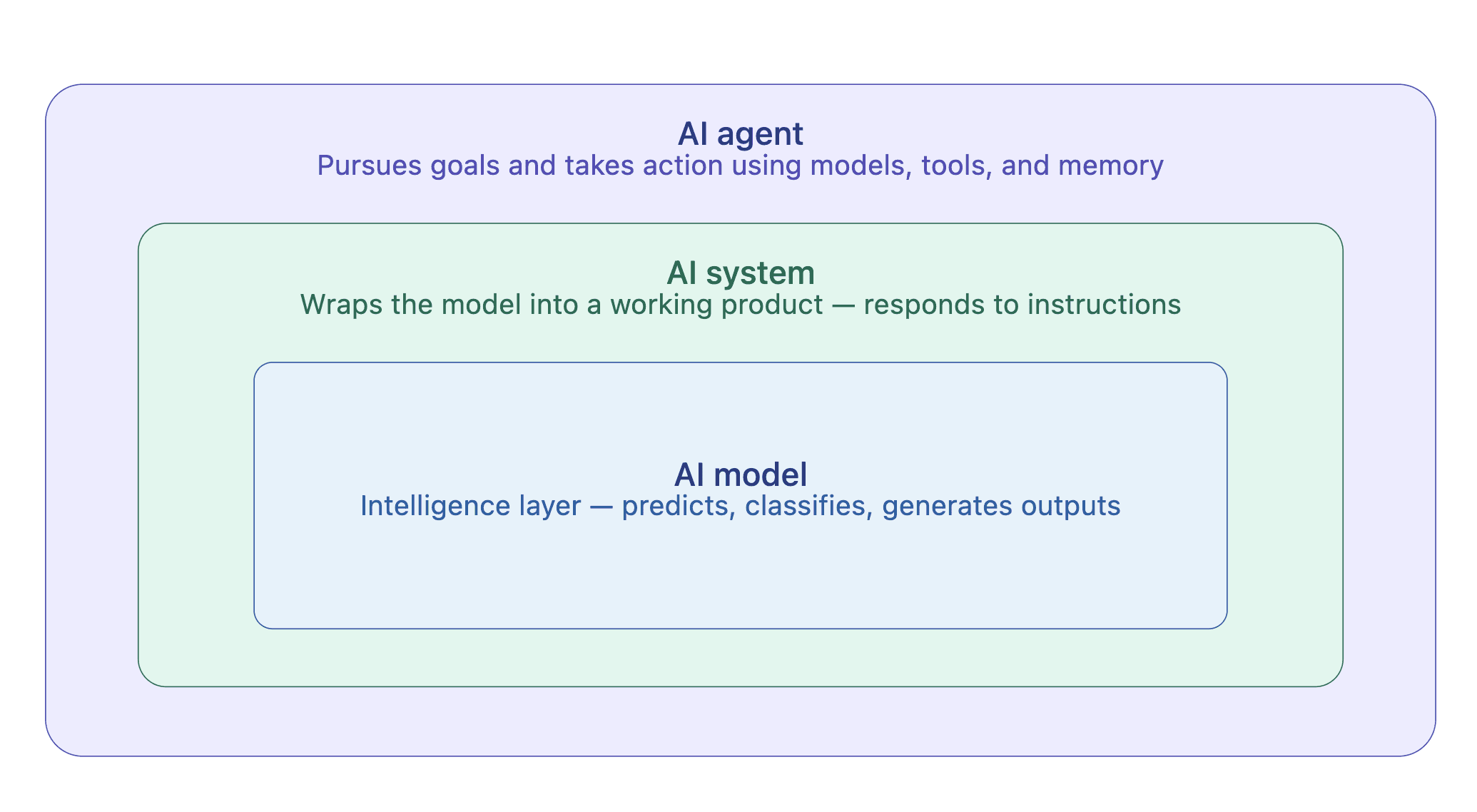
Think of it as three levels. The model is the intelligence layer. The AI system wraps that model into a working product. The agent gives that system the ability to act. Most businesses today operate at the AI system level. True agents are rarer, and they require more infrastructure to run reliably.
How Does an AI Agent Work?
In practice, an AI agent may search the web, retrieve data from a CRM, compare results, draft a response, ask for approval, and then send the final output. That means the agent is not just generating language. It is orchestrating a workflow.
This is the core reason the difference between an AI model and an AI agent matters: the model is usually the reasoning or prediction component, while the agent is the execution layer that turns intelligence into action.
In practice, a single agentic workflow might call several different models: one for reasoning, one for retrieval, and another as a fallback when a provider fails. That means production agents are not just model-dependent — they are multi-model dependent.
AI Model vs AI Agent: 6 Key Differences
Here is the simplest way to frame the comparison:
Dimension | AI Model | AI Agent |
|---|---|---|
Primary role | Generate outputs or predictions | Pursue goals and complete tasks |
Autonomy | Low | Medium to high |
Workflow control | Usually none | Manages multi-step workflows |
Tool use | Typically no direct tool orchestration | Uses APIs, software, search, databases, and other tools |
Memory/context | Often limited or session-based | Can maintain context and state across steps |
Adaptability | Often needs retraining or external logic | Can adjust actions based on changing conditions |
Business value | Intelligence for a task | Execution for an outcome |
A helpful analogy is this: an AI model is like an expert brain you can consult, while an AI agent is like a digital worker that can use that brain to complete a job. The model tells you what might be best. The agent can move the task forward.
Real-World Examples of the Difference Between an AI Model and an AI Agent
Customer Support
Consider customer support. An AI model can classify incoming tickets by topic, sentiment, or urgency. An AI agent can go much further: gather account details, search prior tickets, propose a resolution, escalate if needed, and trigger the correct workflow in your support platform.
Finance
In finance, a model may detect suspicious transactions or forecast risk. An agent could use those outputs to investigate anomalies, collect additional documents, create a case summary, and route it to the right team. In supply chain operations, a forecasting model predicts inventory demand, while an agent can monitor shortages, compare vendors, and initiate downstream actions.
Marketing
For marketing teams, the difference is also clear. A model can generate blog outlines, ad variations, or keyword clusters. An agent can take a broader goal such as “build a competitor content brief,” then search the web, compare SERP structures, extract messaging patterns, draft the article brief, and send it into your publishing workflow.
The Future Is Not Models or Agents. It Is Models Plus Agents
One of the biggest mistakes in the market is treating AI models and AI agents as competing categories. In reality, the strongest systems often combine both. SmartDev describes this as a hybrid direction, where models supply the analytical capability and agents turn those insights into decisions and actions. AWS and Microsoft point in a similar direction by emphasizing orchestration, contextual reasoning, and business process execution on top of foundation models.
That hybrid view is more useful for businesses. A model alone is rarely a finished product. An agent without strong models is rarely intelligent enough.
What companies actually need is a stack that connects the right models, the right tools, and the right routing logic and can adapt as all three change. That is easier to describe than to build. The infrastructure challenge of running multi-model agentic systems is one of the most underestimated costs in production AI today.
How Infron Supports Teams Building Agentic AI Systems
Deciding to build with models and agents together is the easy part. The harder part is what happens when that system needs to run reliably, at scale, across multiple models and providers.
In practice, this is where most enterprise AI projects hit unexpected friction. A real agentic workflow rarely depends on a single model. One task might require a reasoning-heavy model. Another needs something faster and cheaper. A third needs a fallback when the primary provider goes down. Managing those relationships separately each with its own pricing, access pattern, and failure mode creates overhead that grows faster than the system itself.
This is the operational layer that most architecture discussions skip over. It is not glamorous, but it determines whether a production AI system stays maintainable as it scales.
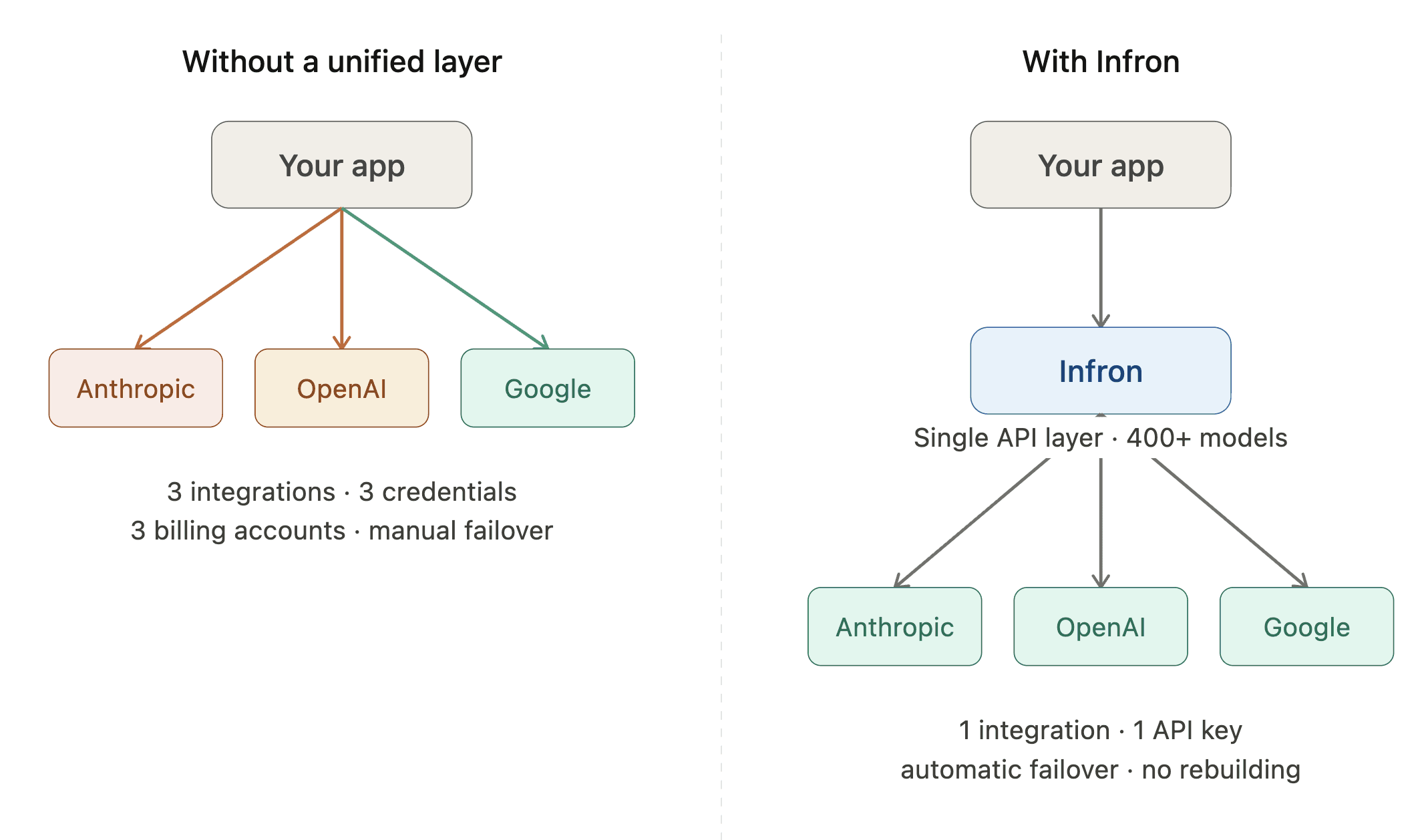
Infron is built specifically for this layer. Instead of managing each model provider individually, teams connect once through Infron's single API and get access to 400+ models across providers. When one provider has an outage, the system keeps running. When a better or cheaper model becomes available, teams can switch without rewriting application logic. Billing stays in one place instead of fragmenting across vendors.
The result is that engineering teams spend less time maintaining the model layer and more time improving the AI workflows that actually deliver business value.
FAQ
Is ChatGPT an AI model or an AI agent?
In its base form, ChatGPT is an AI system — a model that responds to prompts, not one that acts autonomously. Connect it to tools like browsing or code execution, and it starts to behave more like an agent. The model generates the response. The tools are what make it do something.
Can an AI agent work without an AI model?
Older rule-based agents could, but they had no ability to reason or handle unstructured inputs. Most agents built today depend on a language model to interpret goals, plan steps, and decide which tools to use. Without it, you have automation, not agency.
Which is better for business: an AI model or an AI agent?
They solve different problems. If your task is contained — classifying documents, scoring leads, generating drafts — a model is faster and cheaper. If it requires multiple steps, external tools, or judgment across changing inputs, an agent fits better. For most teams, the real question is whether your infrastructure can support both.
Why do companies need unified AI infrastructure for agents?
Because production agents rarely run on one model. Managing each provider separately creates reliability gaps and operational overhead. A unified layer keeps the system running smoothly so teams can focus on building workflows instead of maintaining integrations.