NSFW Roleplay
How to Pick the Best AI for NSFW Roleplay in 2026

Date
Author
Andrew Zheng
Type "best AI for NSFW roleplay" into Google and you'll get a dozen articles that all claim to have found the definitive winner. Read three of them back to back and the picks barely overlap. That isn't because the writers disagree about what's good. It's because they're all comparing the same surface layer, and the things that actually determine whether a platform works for you sit underneath it.
Why Every "Best AI for NSFW Roleplay" List Disagrees
Chat Apps and Roleplay Models Are Not the Same Product
Most rankings in this space are NSFW AI chat app rankings. They compare finished consumer products: interface, subscription price, free tier, whether there's voice, how good the image generation is.
A roleplay model is the thing underneath. The same model can appear in five different apps and behave differently in each one, because each app wraps it in its own filtering, its own memory handling, and its own data policy. When someone tells you a model is great or terrible, they're usually describing the wrapper.
That matters because roleplay isn't a series of one-off replies. You're building a character, a setting, and a story that has to hold together across dozens of messages. The wrapper decides whether it does.
The Feature Comparisons Everyone Runs, and What They Miss
Feature comparisons answer "what can this product do." They don't answer "what is this product doing with what I write," "why did it just refuse me," or "why did my character forget her own backstory an hour in."
Those three questions have concrete answers, and the answers live in a platform's terms, its architecture, and a few minutes of testing. They're just not the sort of thing that fits in a comparison grid, so nobody checks them.
Four Platform-Level Checks
Check | The question | Where the answer lives |
|---|---|---|
1. What it keeps | Is logging on by default or opt-in, and can you actually delete things? | Terms of service and privacy policy |
2. Where the filters live | Is a refusal coming from the model or from a layer the platform added? | Model documentation, plus testing the same model elsewhere |
3. What breaks first | How does the app handle a conversation longer than the context window? | Documentation, or a long test session |
4. What stays off limits | Does the platform run real age assurance, and is it clear about what it won't host? | Terms, and whether there's an actual age check at signup |
None of these are hard. All four are answerable before you invest hours in a character.
Check 1. What the Platform Keeps
Is Logging Default-On or Opt-In?
This is the single most useful question because it's binary and it's usually stated plainly.
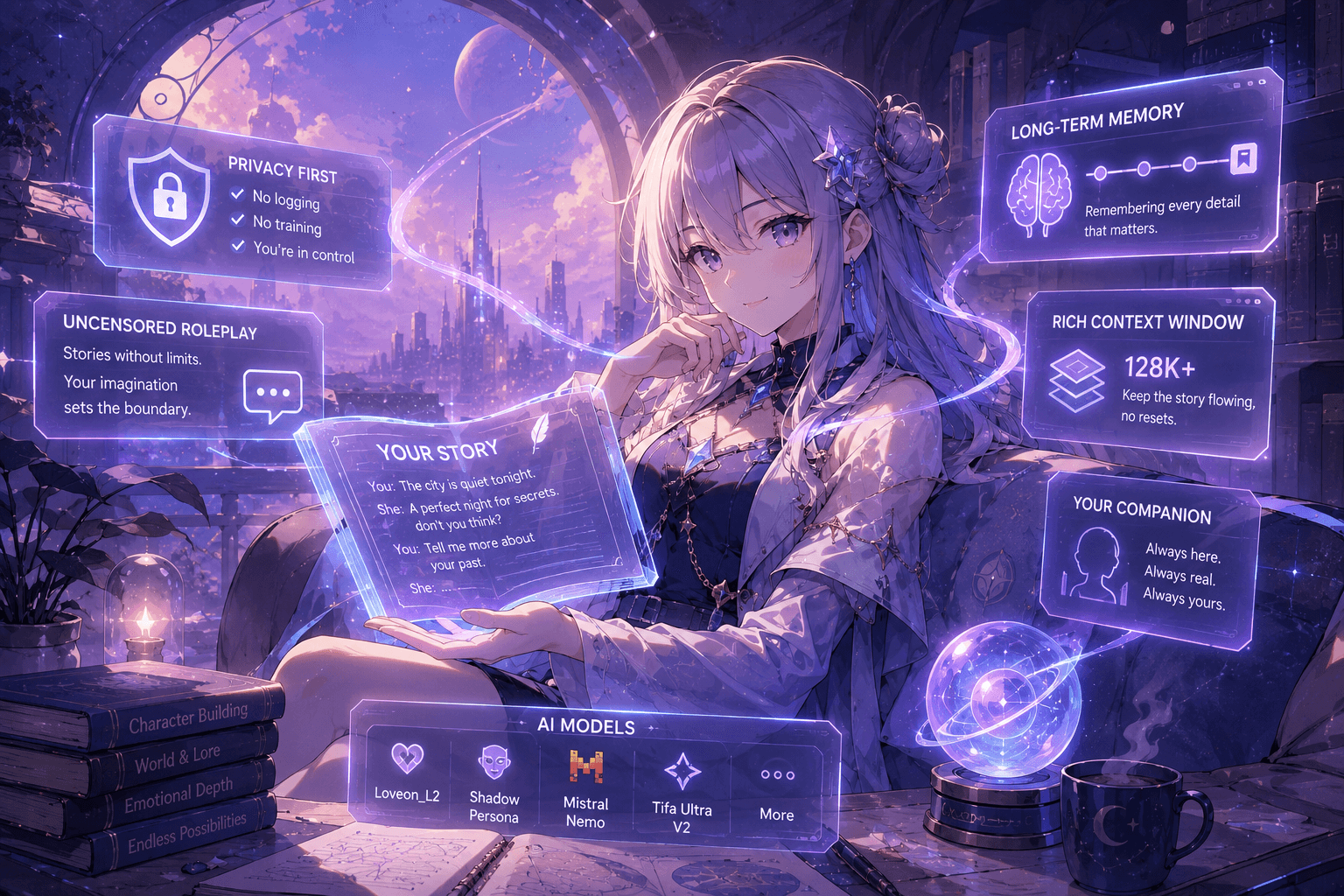
Some platforms reserve the right to log everything in the terms of service and leave it on. Others make it a permission you grant. Infron takes the second approach: prompt logging and chat logging are both opt-in permissions granted through account settings, so neither applies unless you switch it on.
The distinction matters more than any privacy marketing copy. "We care about your privacy" is a sentence. "Logging is off unless you enable it" is a default you can verify in the terms.
What Happens After the Request Leaves the Gateway
This is the part most guides skip entirely, and it applies to any platform that doesn't run the model itself.
A gateway routes your request to whoever actually hosts the model. The gateway's policy covers the gateway's handling. The provider on the other end has its own terms. Infron states that it has opted out of model training with the AI Models it uses where that option exists, but the underlying provider's terms still govern what happens on their side.
If the story matters to you, read both. If a platform never mentions the second one, that's worth noticing on its own.
Deletion, and Whether It Is Real
There's a difference between deletion and hiding something from your own view. Look for whether the platform describes an actual process.
On Infron, account deletion is an email request followed by a confirmation step, and it can't be reversed once confirmed. Data the company is legally required to retain is the standard exception, and essentially every platform has one.
Reading the Carve-Outs Without Panicking
Even good policies reserve some room. De-identified inputs used for analytics. The ability to re-associate stored data during debugging. Aggregate data shared with partners.
None of that is a red flag by itself. It's the difference between "nothing is ever stored" and "nothing is stored unless you opt in, with these named exceptions." The second is what most honest policies actually say, and a platform claiming the first without qualification is either being loose with language or hasn't thought about it.
Here's why ten minutes of reading is worth it. Content generated in an app that logs by default could resurface in a breach, get flagged in a routine audit, or get referenced by a support agent troubleshooting your account. None of that requires bad intent. It's what happens when data sits somewhere longer than it needs to.
Check 2. Which Layer Is Actually Blocking You
Three Places Filtering Can Live
"Uncensored" doesn't mean a model has no rules. It means someone made different choices about where those rules sit.
Layer | Where it lives | What it does |
|---|---|---|
Base model training | Original pretraining and alignment | Sets the model's default disposition. Hardest to change |
Fine-tuning | A pass on top of the base model | Where most uncensored variants get made, by weakening refusal behaviour. Tends to reduce refusals broadly rather than opening one specific category |
Platform moderation | A separate system in front of or behind the model | Blocks requests or responses regardless of what the model would have done |
Why a Mid-Scene Refusal Is Usually Not the Model
If a session has ever cut off mid-sentence for no clear reason, that's almost always the third layer.
A model can be thoroughly permissive at the fine-tuning level and still get stopped by a strict moderation system sitting in front of it. The refusal you see is the platform's, not the model's, and no amount of prompt engineering gets around it because the model never saw the request.
This changes what's worth comparing. Not "is this app uncensored, yes or no," but which layer applies, and whether a wide enough model catalogue gives you a way to route around the layer that's been bothering you.
The Same Model, Two Opposite Reputations
It's also why two people can use the identical base model on different platforms and come away with completely opposite opinions of it. One platform bolts on a strict layer. Another exposes the model much closer to how it was actually tuned.
When you read that a model is great or useless for uncensored AI roleplay, check where the person was running it. Half the disagreements online are about wrappers, not models.
Check 3. What Happens When the Story Outgrows the Model
The Context Window Is a Ceiling, Not a Memory
Every model has a context window: the amount of text it can process at once, measured in tokens, which are roughly pieces of words. Your entire conversation gets fed back in with every new message, so a long session steadily fills it up.
The model doesn't have memory in the way the word usually implies. It has a window, and everything outside the window may as well not exist.
Three Truncation Strategies and What Each One Loses
What happens once you exceed the window is a choice the application makes, not something the model does on its own. Three approaches are common:
Strategy | How it works | What you lose |
|---|---|---|
Drop oldest | Removes the earliest messages first | Your character definition, if it was in message one |
Sliding window with pinned prompt | Keeps the system prompt, discards old turns | Mid-story details and callbacks |
Summarisation | Compresses earlier turns into a note | Specific wording and texture, keeps the plot skeleton |
Which one your platform uses determines whether a backstory survives hour three or quietly disappears. It's rarely documented, but it's easy to test: mention something distinctive early, keep going for a long session, then ask about it.
Two Habits That Keep a Character Alive
Put the character definition in the system prompt rather than in an early message. Most truncation strategies protect the system prompt and discard everything else, so this one placement decision does more for consistency than any model choice.
Then recap key details periodically instead of assuming they're still in context. It costs a sentence and saves a scene.
Finding a Model's Context Length
For mainstream models this is published in the API documentation and easy to look up. For smaller community fine-tunes, including a lot of the roleplay-specific ones, it often isn't documented anywhere.
When it isn't published, testing is faster than searching. Run a long session, drop in a detail early, and see how far it survives.
Check 4. What the Platform Will Not Host
Quick disclaimer: this is general information, not legal advice. Rules vary by country and by state, so check your own situation if you're unsure.
Age Assurance Became a Legal Requirement, Not a Courtesy
Most guides treat age checks as a nice-to-have that varies by provider. That stopped being accurate.
Under the UK Online Safety Act, services carrying pornographic content have had to run highly effective age assurance since July 2025, and self-declaration no longer counts. Ofcom's enforcement has since moved past traditional adult sites: in January 2026 it opened formal investigations into generative AI services. Australia's Age-Restricted Material Codes, in effect from March 2026, explicitly cover AI chatbots. The EU applies minor-protection duties through the Digital Services Act, and a growing number of US states require age verification for adult content.
The practical read for a user: if a platform is still asking you to tick a box confirming you're over 18, that tells you where it sits relative to the current rules in several major markets.
The Two Lines That Apply Regardless of Jurisdiction
Two categories are criminal in essentially every jurisdiction, and no platform's permissiveness changes that.
Sexual content involving minors, including when it's entirely AI-generated and no real person exists. And sexual content depicting identifiable real people without their consent. In the United States the TAKE IT DOWN Act made knowing publication of non-consensual intimate imagery a federal crime in May 2025, explicitly including AI-generated material, and platform takedown obligations became enforceable by the FTC in May 2026.
A platform that is clear about these limits is not being restrictive. It's telling you it has read the law. One that implies anything goes has either not read it or is hoping you won't.
Where Jurisdiction Actually Changes the Answer
Between those two points there's a wide space of ordinary private adult fiction where the variables are genuinely local: your jurisdiction, the platform's terms, and where the platform operates from.
That's the part worth checking for your own situation, and a platform's terms of service will tell you more about it than a generic search result will.
Scoring the Best AI for NSFW Roleplay Against Your Own Needs
Nobody Wins All Four
The four checks pull in different directions, and no category of platform sweeps them.
Consumer chat apps are built for people, so they tend to be furthest along on age assurance and easiest to start with. They're also the most likely to log by default, the most opaque about which layer refused you, and the least likely to tell you their truncation strategy.
Gateways and API platforms are built for developers. They tend to be more explicit about data handling, more transparent about which model you're actually hitting, and wider in catalogue. They're infrastructure rather than consumer products, which means consumer-facing protections aren't usually their design point.
Local deployment wins outright on data handling and loses on everything requiring scale or convenience.
Any platform claiming to lead on all four is worth a second look at the terms.
Which Trade-Off Fits Which Kind of Story
If you care most about | Weight these checks | Accept the cost |
|---|---|---|
Nothing traceable back to you | 1, heavily | Fewer features, more setup |
Never being interrupted mid-scene | 2 | You'll be picking models yourself |
A story running for months | 3 | Managing your own recaps and prompts |
Knowing exactly where you stand | 4 | Some platforms are off the table |
There's no single best AI for NSFW roleplay, because those four rows don't rank the same way for any two people. Work out which row is yours and the field narrows fast.
How Infron Handles the Four Checks
Infron is a gateway to 400+ AI models through a single API, including a set the team has selected for roleplay. That architecture shapes how it scores.
Logging Is Opt-In
Prompt logging and chat logging are permissions you grant in account settings, not defaults you have to opt out of after the fact. The caveat from Check 1 still applies: that covers Infron's own handling, and the model provider on the other end has its own terms.
A Catalogue Wide Enough to Route Around a Filter Layer
The roleplay selection currently includes Loveon_L and Loveon_L2 for emotionally driven scenarios, Shadow-Persona for characters with multiple or conflicting personalities, Tifa-Ultra-v2 for character consistency, L3-Lunaris-8B for creative narrative, and Mistral-Nemo for complex multi-scenario plots.
The point of the breadth isn't the count. It's that when a particular setup keeps interrupting you, having somewhere else to route is the only real fix, because Check 2 problems can't be prompted away.
Switching Models Without Rebuilding the Character
Because everything runs through one API, moving from Mistral-Nemo to Tifa-Ultra-v2 means changing a model string. Your system prompt, character definition, and conversation history live on your side, so nothing gets rebuilt when you switch.
That also means Check 3 is partly yours to solve. A gateway hands you the context window and the model. What you do when a conversation outgrows it is your architecture, which is more control and more work than an app that decides for you.
On Check 4, an API platform is developer infrastructure rather than a consumer adult service, so the age assurance question is one to read the current terms on directly rather than take from a blog post, including this one.
FAQ
What does "uncensored" mean in an NSFW AI roleplay context?
Usually that a model has been fine-tuned after training to reduce how often it refuses, not that it has no rules. Models are tuned differently, and whichever platform serves them may add its own moderation layer on top, which is why two models under the same uncensored AI chat label can behave nothing alike.
How does AI memory work in long roleplay sessions?
The model processes a fixed amount of text at once, called the context window. Once a conversation exceeds it, the application decides what to cut: oldest messages, a sliding window around the system prompt, or a summary of earlier turns. That choice, more than the model, determines how long a character stays consistent.
What's the difference between an NSFW AI chat app and a roleplay model?
An app is a finished product built around one model or a few, with its own interface, pricing, filtering, and memory handling. A model is the AI underneath, reachable through multiple apps and APIs, and it behaves differently depending on which wrapper you reach it through.
Which roleplay models does Infron offer?
Loveon_L, Loveon_L2, Shadow-Persona, Tifa-Ultra-v2, L3-Lunaris-8B, and Mistral-Nemo, within a wider catalogue of 400+ AI models.
Can I switch models without losing my character setup?
On a single-API platform, yes, because the character definition sits in your system prompt on your side and switching is a matter of changing which model you call. On apps that store character setups internally, it depends entirely on the app, and some make you rebuild.