> For the complete documentation index, see [llms.txt](https://infronai.gitbook.io/docs/llms.txt). Markdown versions of documentation pages are available by appending `.md` to page URLs; this page is available as [Markdown](https://infronai.gitbook.io/docs/test-cases/performance-stress-testing.md).
# Performance Stress Testing
Infron AI Performance Stress Testing Guide.
### Overview
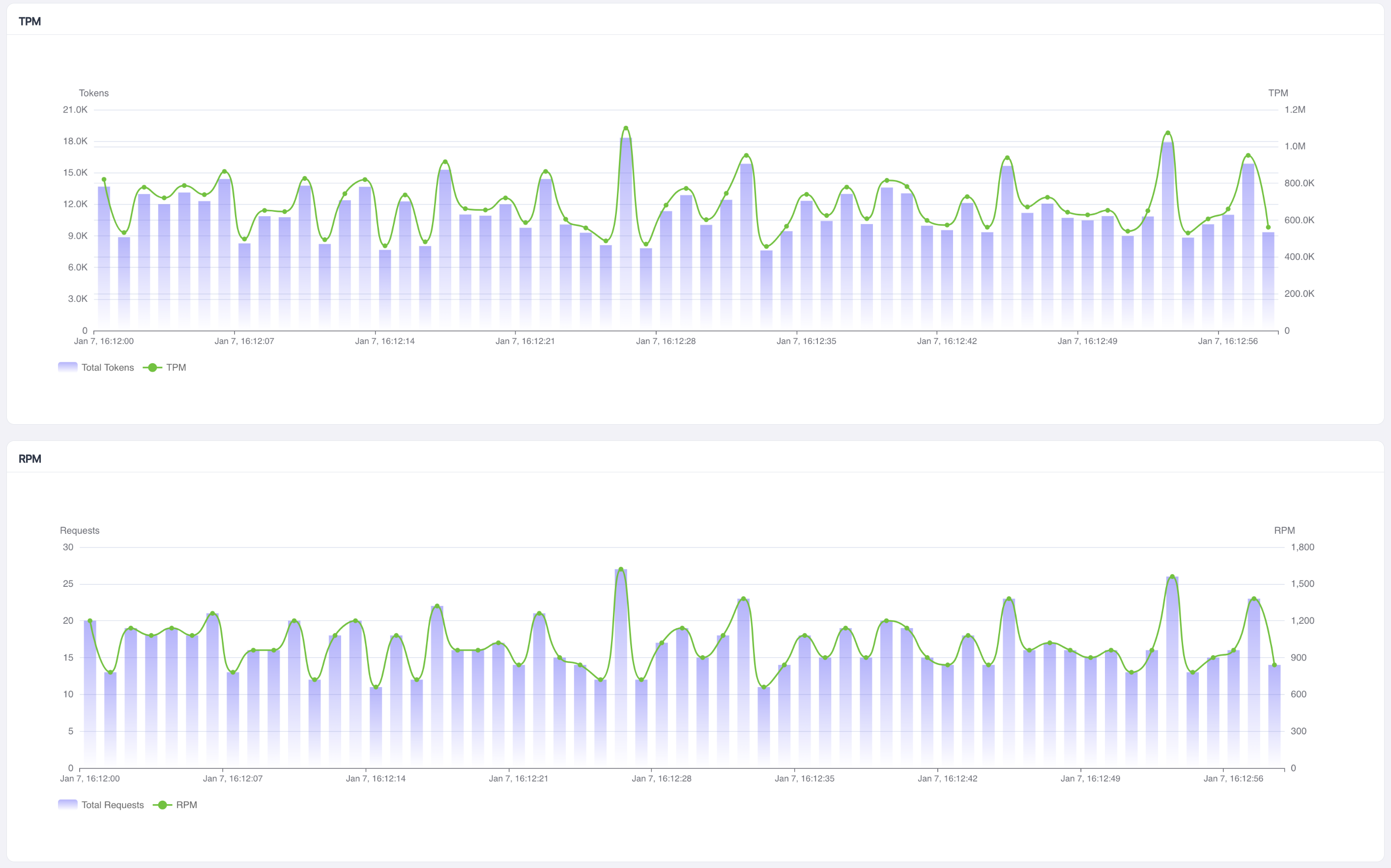
Performance testing, also known as **stress or load testing**, is a technical process used to evaluate how a system performs under specific workloads. For network devices such as Infron AI, performance testing helps determine its capacity limits, stability, and efficiency in handling large volumes of requests or traffic.
The primary measurement indicators include:
* **QPS (Queries per Second):** The number of requests the router can successfully process per second.
* **Latency (Response Time):** The time taken for a request to be processed and a response returned.
* **Throughput:** The total amount of data that can be transmitted over the network per unit time.
* **Packet Loss Rate:** The percentage of packets that are dropped during transmission.
* **CPU and Memory Utilization:** Hardware resource usage during high-load scenarios.
### Testing Objectives
Performance testing ensures that Infron AI:
* Maintains stable performance under expected peak loads.
* Handles abnormal or sudden traffic surges without network interruption.
* Meets service level agreements (SLAs) for latency and throughput.
* Provides clear data points for capacity planning and future optimization.
#### Testing Guide
#### **1. Environment Setup**
Requirements:
* Python ≥ 3.9
* `requests` or `httpx`
* Access to Infron AI and direct model endpoints.
```bash
pip install requests
```
#### **2. Account & API Keys Setup**
The first step to start using Infron is to [create an account](https://infron.ai/login) and [get your API key](https://infron.ai/dashboard/apiKeys).
The second step to start using Google AI Studio is [create a project](https://aistudio.google.com/app/projects) and [get your API Key](https://aistudio.google.com/app/api-keys).
#### **3. Code Script Example**
```python
import time
import argparse
import os
from concurrent.futures import ThreadPoolExecutor, as_completed
from typing import Dict, Any, Optional
from openai import OpenAI
def create_client(base_url: str, api_key: str) -> OpenAI:
return OpenAI(base_url=base_url, api_key=api_key)
def send_request(client: OpenAI, model: str, prompt: str) -> Dict[str, Any]:
start = time.perf_counter()
usage: Optional[Dict[str, int]] = None
status_ok = False
try:
completion = client.chat.completions.create(
model=model,
messages=[{"role": "user", "content": prompt}],
extra_body={"usage": {"include": True}},
)
status_ok = True
usage_obj = getattr(completion, "usage", None)
if usage_obj:
usage = {
"prompt_tokens": getattr(usage_obj, "prompt_tokens", 0) or 0,
"completion_tokens": getattr(usage_obj, "completion_tokens", 0) or 0,
"total_tokens": getattr(usage_obj, "total_tokens", 0) or 0,
}
except Exception as e:
return {
"ok": False,
"error": str(e),
"latency_ms": (time.perf_counter() - start) * 1000,
"finished_at": time.perf_counter(),
"usage": usage,
}
return {
"ok": status_ok,
"latency_ms": (time.perf_counter() - start) * 1000,
"finished_at": time.perf_counter(),
"usage": usage,
}
def percentile(values, p):
if not values:
return 0.0
s = sorted(values)
k = max(0, min(len(s) - 1, int(round((p / 100.0) * (len(s) - 1)))))
return s[k]
def print_summary(results, wall_time_s):
latencies = [r["latency_ms"] for r in results]
ok_count = sum(1 for r in results if r["ok"])
err_count = len(results) - ok_count
avg_latency = sum(latencies) / len(latencies) if latencies else 0.0
p50 = percentile(latencies, 50)
p90 = percentile(latencies, 90)
p95 = percentile(latencies, 95)
p99 = percentile(latencies, 99)
total_tokens = 0
for r in results:
u = r.get("usage")
if u and isinstance(u, dict):
total_tokens += int(u.get("total_tokens", 0) or 0)
rpm_overall = (len(results) / (wall_time_s / 60.0)) if wall_time_s > 0 else 0.0
tpm_overall = (total_tokens / (wall_time_s / 60.0)) if wall_time_s > 0 else 0.0
print("Summary")
print(f"Requests: {len(results)}, Success: {ok_count}, Errors: {err_count}")
print(f"Wall Time: {wall_time_s:.2f}s, RPS: {len(results)/wall_time_s if wall_time_s>0 else 0:.2f}")
print(f"Latency(ms): avg={avg_latency:.2f}, p50={p50:.2f}, p90={p90:.2f}, p95={p95:.2f}, p99={p99:.2f}")
print(f"RPM Overall: {rpm_overall:.2f}")
print(f"TPM Overall: {tpm_overall:.2f}")
def print_minute_breakdown(results, start_wall):
buckets: Dict[int, Dict[str, Any]] = {}
for r in results:
finished_at = r["finished_at"]
minute_idx = int((finished_at - start_wall) // 60)
b = buckets.setdefault(minute_idx, {"requests": 0, "tokens": 0})
b["requests"] += 1
u = r.get("usage")
if u and isinstance(u, dict):
b["tokens"] += int(u.get("total_tokens", 0) or 0)
print("Per-Minute")
for k in sorted(buckets.keys()):
b = buckets[k]
print(f"Minute {k}: RPM={b['requests']}, TPM={b['tokens']}")
def run_qps_mode(qps: float, duration_s: int, concurrency: int, base_url: str, api_key: str, model: str, prompt: str):
client = create_client(base_url, api_key)
total_requests = int(qps * duration_s)
results = []
start_wall = time.perf_counter()
with ThreadPoolExecutor(max_workers=concurrency) as executor:
futures = []
start_schedule = time.perf_counter()
for i in range(total_requests):
next_time = start_schedule + i / qps
now = time.perf_counter()
sleep_s = next_time - now
if sleep_s > 0:
time.sleep(sleep_s)
futures.append(executor.submit(send_request, client, model, prompt))
for f in as_completed(futures):
results.append(f.result())
wall_time_s = time.perf_counter() - start_wall
print_summary(results, wall_time_s)
print_minute_breakdown(results, start_wall)
def run_burst_mode(tasks: int, concurrency: int, base_url: str, api_key: str, model: str, prompt: str):
client = create_client(base_url, api_key)
results = []
start_wall = time.perf_counter()
with ThreadPoolExecutor(max_workers=concurrency) as executor:
futures = [executor.submit(send_request, client, model, prompt) for _ in range(tasks)]
for f in as_completed(futures):
results.append(f.result())
wall_time_s = time.perf_counter() - start_wall
print_summary(results, wall_time_s)
print_minute_breakdown(results, start_wall)
def main():
parser = argparse.ArgumentParser()
parser.add_argument("--mode", type=str, default="qps", choices=["qps", "burst"])
parser.add_argument("--qps", type=float, default=10.0)
parser.add_argument("--duration", type=int, default=60)
parser.add_argument("--concurrency", type=int, default=4)
parser.add_argument("--tasks", type=int, default=200)
parser.add_argument("--base-url", type=str, default="https://llm.onerouter.pro/v1")
parser.add_argument("--api-key", type=str, default="")
parser.add_argument("--model", type=str, default="vertex/qwen3-next-80b-a3b-instruct")
parser.add_argument("--prompt", type=str, default="What is the meaning of life?")
args = parser.parse_args()
if not args.api_key:
raise SystemExit("Missing --api-key or ONEROUTER_API_KEY")
if args.mode == "qps":
run_qps_mode(args.qps, args.duration, args.concurrency, args.base_url, args.api_key, args.model, args.prompt)
else:
run_burst_mode(args.tasks, args.concurrency, args.base_url, args.api_key, args.model, args.prompt)
if __name__ == "__main__":
main()
```
#### 4. Run Testing
```bash
python3 OneRouter/llm_load_test.py --qps 16.67 --duration 120 --concurrency 150 --model "vertex/qwen3-next-80b-a3b-instruct" --api-key "Replace with your key"
```
Summary
```
Requests: 2000, Success: 2000, Errors: 0
Wall Time: 125.86s, RPS: 15.89
Latency(ms): avg=4657.20, p50=4602.80, p90=5634.60, p95=5997.43, p99=7177.60
RPM Overall: 953.41
TPM Overall: 649570.29
Per-Minute
Minute 0: RPM=917, TPM=625730
Minute 1: RPM=1022, TPM=695261
Minute 2: RPM=61, TPM=41634
```
---
# Agent Instructions
This documentation is published with GitBook. GitBook is the documentation platform designed so that both humans and AI agents can read, navigate, and reason over technical content effectively. Learn more at gitbook.com.
## Querying This Documentation
If you need additional information that is not directly available in this page, you can query the documentation by asking a question.
Perform an HTTP GET request on the following URL with the `ask` and `goal` query parameters:
```
GET https://infronai.gitbook.io/docs/test-cases/performance-stress-testing.md?ask=&goal=
```
`ask` is the immediate question: it should be specific, self-contained, and written in natural language.
`goal` is what the user is ultimately trying to achieve, the reason they need the answer. Sharing it helps GitBook give you a better, more relevant answer. A goal is most helpful when it describes the outcome the user wants rather than restating the question. For example, with `ask=how do I create an API token`, a goal like `automate deployments from our CI pipeline` lets GitBook tailor the answer to that use case.
The response will contain a direct answer to the question and relevant excerpts and sources from the documentation.
Use this mechanism when the answer is not explicitly present in the current page, you need clarification or additional context, or you want to retrieve related documentation sections.