> For the complete documentation index, see [llms.txt](https://infronai.gitbook.io/docs/llms.txt). Markdown versions of documentation pages are available by appending `.md` to page URLs; this page is available as [Markdown](https://infronai.gitbook.io/docs/features/structured-outputs.md).
# Structured Outputs
Return structured data from your models.
Infron supports **structured outputs** for **compatible models**, ensuring responses follow a specific schema format. This feature is particularly useful when you need consistent, well-formatted responses that can be reliably parsed by your application.
Structured outputs allow you to:
* Enforce specific JSON Schema validation on model responses
* Get consistent, type-safe outputs
* Avoid parsing errors and hallucinated fields
* Simplify response handling in your application
### Model Support
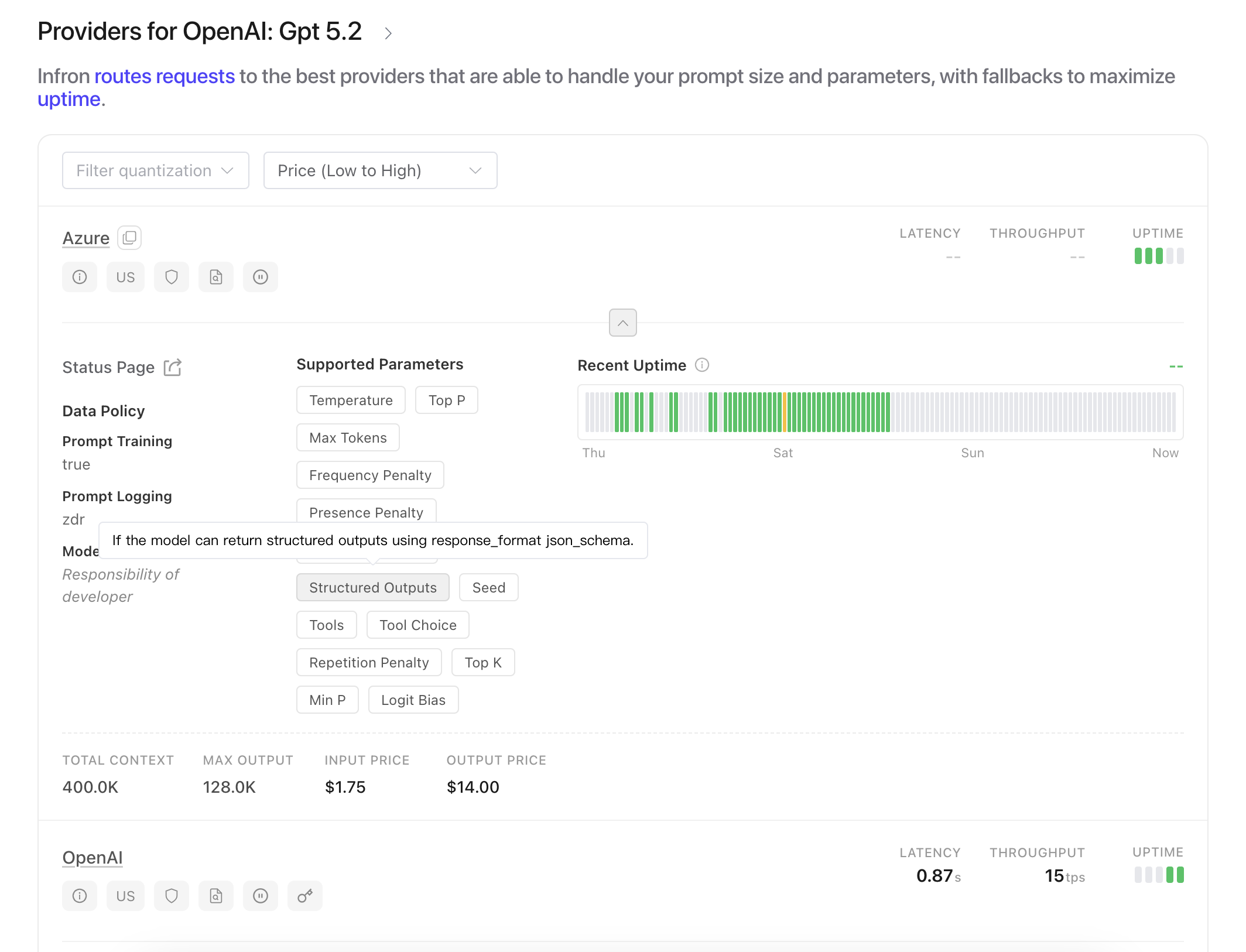
To ensure your chosen model supports structured outputs:
1. Check the model's supported parameters on the [models page](https://infron.ai/models)
2. Include `response_format` and set `type: json_schema` in the required parameters
### Using Structured Outputs
To use structured outputs, include a `response_format` parameter in your request, with `type` set to `json_schema` and the `json_schema` object containing your schema:
#### json\_scheme
{% tabs %}
{% tab title="Python (json\_schema)" %}
```python
import requests
import json
response = requests.post(
url="https://llm.onerouter.pro/v1/chat/completions",
headers={
"Authorization": "Bearer ",
"Content-Type": "application/json"
},
data=json.dumps({
"model": "openai/gpt-5.2",
"messages": [
{"role": "user", "content": "What's the weather like in London?"}
],
"response_format": {
"type": "json_schema",
"json_schema": {
"name": "weather",
"strict": True,
"schema": {
"type": "object",
"properties": {
"location": {
"type": "string",
"description": "City or location name"
},
"temperature": {
"type": "number",
"description": "Temperature in Celsius"
},
"conditions": {
"type": "string",
"description": "Weather conditions description"
}
},
"required": ["location", "temperature", "conditions"],
"additionalProperties": False
}
}
}
})
)
print(response.json()["choices"][0]["message"]["content"])
```
{% endtab %}
{% endtabs %}
The model will respond with a JSON object that strictly follows your schema:
```json
{
"conditions": "Overcast with light rain showers",
"location": "London, United Kingdom",
"temperature": 12.5
}
```
#### CalendarEvent
{% tabs %}
{% tab title="Python (CalendarEvent)" %}
```python
import requests
import json
response = requests.post(
url="https://llm.onerouter.pro/v1/chat/completions",
headers={
"Authorization": "Bearer ",
"Content-Type": "application/json"
},
data=json.dumps({
"model": "openai/gpt-5.2",
"messages": [
{"role": "system", "content": "Extract the event information."},
{
"role": "user",
"content": "Alice and Bob are going to a science fair on Friday.",
}
],
"response_format": {
"type": "CalendarEvent"
}
})
)
print(response.json())
```
{% endtab %}
{% endtabs %}
The response example:
```json
{
'id': 'gen-1766491236-RRKOrbaRaoxv1ogA56cd',
'model': 'gpt-5.1',
'object': 'chat.completion',
'created': 1766491236,
'choices': [{
'index': 0,
'message': {
'role': 'assistant',
'content': '- Event: Science fair \n- Participants: Alice, Bob \n- Date: Friday \n- Location: Not specified',
'reasoning': "**Extracting event information**\n\nI need to pull event details from the user's sentence, but I’m not sure about the exact format they want. Probably it should be brief, including the event name, date, participants, and location. For example, if it's a science fair, I might list the day as Friday with participants being Alice and Bob. However, I notice there's no location mentioned, so I’ll keep my answer concise while ensuring I cover everything necessary!",
'reasoning_details': [{
'id': '',
'format': 'openai-responses-v1',
'index': 0,
'type': 'reasoning.summary',
'data': ''
}, {
'id': 'rs_0ae935064fdad29601694a8464e37c81908e9a2d8154046487',
'format': 'openai-responses-v1',
'index': 0,
'type': 'reasoning.encrypted',
'data': 'gAAAAABpSoRojMddY32GRTMLysJlQBXeniX2FaZJJL7MUvWNRcqNOdQBtE4xfOW7nUXlehVdMCiSlGm1jvi8u7ukprfSa2F9bca_V-XBq_DxzdiecWn08qM3wDA5Xe_GpcST_BGaIsEWSCFKqg0d7chukEHqD2-20NBSYU8XAbIKiSCcoiwduuxBDw1S8UdCbuBFuF9D_B_jiDlgWguMYEST3BGbb35qR261BlsB2E3obmW6CX2D96cyFk8ZrOXRd7aytqxgMSa-k2l0yJSMFvWMlrY7DhC80cIhgmQWfl-jVknCyURFMjN1_g0Jzzdfh2O_nooLVqJmH-j3mFhCsw9SnDFMW_jhrSry6956BIp1aPtYDDusYpb-CLHqBbJtzjzCod8OfBrtWNfRwa3eQkMZQ9F53i0q3cqNan-TWistHZBunH8vI6StAwhh3J1LMHSROXgCPJKq2VPfaNhS1ZbLxvohoHdddBxeNMrwC6qGNADeOx9zTvawqoVGc-4ivsDM2lhBSb8L1iKBEuKK38pnb8Pk8kpIqz7e-5n6_fl9VW5SoGJbobSuVQ7QwyMvvd94clcUZE0nNOtJT2X24t05XX8vqAmdDsRB3th_NNDW3RHxqCxJ0NiNZPq0o69UpGJzU5_o87Z0b1iSeY_WWcptdAs46y44c7YPLB_eW7VXMzuthC-4wmftJF_6ZP_uzHjF_f9otc7GkkiRtW9vZHdVYvV2mBVwuFUNKebTnOkXc-7xQQRqdhvzi1-Te-9uNsqtRqVYeqRrQJQJuDfhtZzTbxyyPq3ilO0AnVVE_Mu84CnUjE_xr1fJidXttMKRbQhsWcGVMmxI-uEExeMLbaKNiRTEcjUZtQukDNXeUaUtzHFk80G5tQAH6bJymAkIE1b7x9glW4Vr2cxRN36UhENl9raF0Oak2A8mAQ9_zkAzL_Yb49QeiHP18YSuklKNzc7dQwv6DqdQ7m4-mmRY3mUP4sLRthDb_l8M99DR506mwJQ03xj4THVG6c3zB-qyt7CrxZHUdFBtkZRG5YoZHf_7KCQ7ARCo-gndMJH9AAGwe-WXYR8eJ8_aiXQx0JyzAvIlIdtMXXa_d7VQJ6YVPhK21kRLv_FqOVvGudBv3AJWpyQLPpnbbIY='
}]
},
'finish_reason': 'stop',
'native_finish_reason': 'completed',
'logprobs': None
}],
'request_id': '112648cf661f4650ac3c3cdc38832972',
'usage': {
'prompt_tokens': 27,
'completion_tokens': 78,
'total_tokens': 105,
'prompt_tokens_details': {},
'completion_tokens_details': {
'reasoning_tokens': 49
},
'input_tokens': 0,
'output_tokens': 0,
'ttft': 0,
'server_tool_use': {
'web_search_requests': ''
}
}
}
```
### Streaming with Structured Outputs
Structured outputs are also supported with streaming responses. The model will stream valid partial JSON that, when complete, forms a valid response matching your schema.
To enable streaming with structured outputs, simply add `stream: true` to your request:
```json
{
"stream": true,
"response_format": {
"type": "json_schema",
// ... rest of your schema
}
}
```
### Best Practices
1. **Include descriptions**: Add clear `descriptions` to your `schema properties` to guide the model
2. **Use strict mode**: Always set `strict: true` to ensure the model follows your schema exactly
### Error Handling
When using structured outputs, you may encounter these scenarios:
1. **Model doesn't support structured outputs**: The request will fail with an error indicating lack of support
2. **Invalid schema**: The model will return an error if your JSON Schema is invalid
---
# Agent Instructions
This documentation is published with GitBook. GitBook is the documentation platform designed so that both humans and AI agents can read, navigate, and reason over technical content effectively. Learn more at gitbook.com.
## Querying This Documentation
If you need additional information that is not directly available in this page, you can query the documentation dynamically by asking a question.
Perform an HTTP GET request on the current page URL with the `ask` query parameter, and the optional `goal` query parameter:
```
GET https://infronai.gitbook.io/docs/features/structured-outputs.md?ask=&goal=
```
`ask` is the immediate question: it should be specific, self-contained, and written in natural language.
`goal` is optional and describes the broader end goal you are ultimately trying to accomplish on behalf of the user. GitBook uses it to tailor the answer towards what is most useful for that goal.
The response will contain a direct answer to the question and relevant excerpts and sources from the documentation.
Use this mechanism when the answer is not explicitly present in the current page, you need clarification or additional context, or you want to retrieve related documentation sections.